If you have ever watched a digital video with a narration so smooth you weren’t sure if a real person recorded it—you were likely listening to synthetic speech.
AI voice technology used to sound robotic, stilted, and mechanical. However, breakthroughs in deep learning architectures have closed the gap between machine output and human speech.
This comprehensive guide delivers an evaluation of the best AI voice generators available today. This analysis bypasses marketing copy to focus on real-world testing across YouTube production scripts, corporate e-learning modules, and client-facing digital media assets.
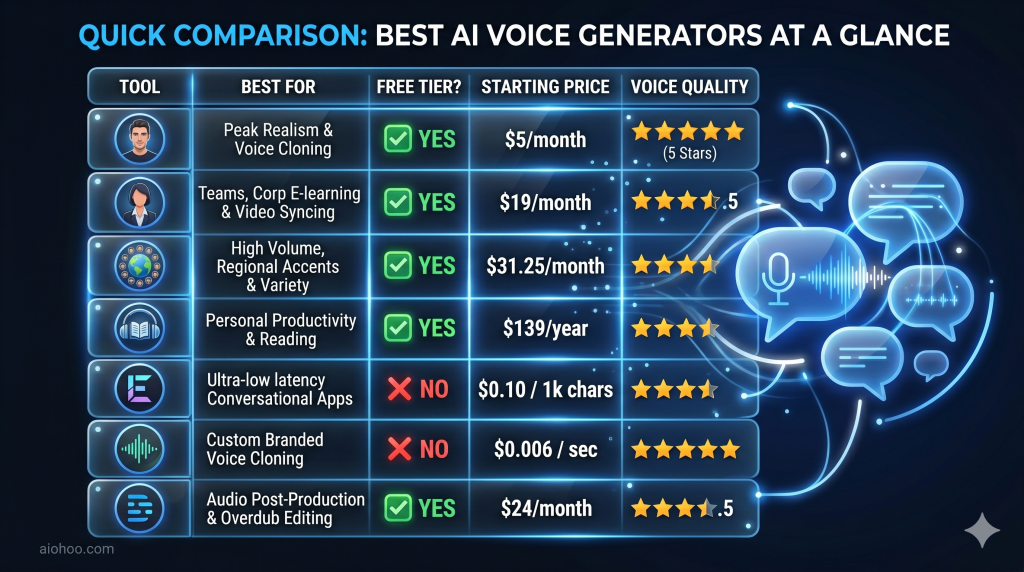
Quick Comparison: Best AI Voice Generators at a Glance
Deep Dive: The Top 7 AI Voice Gen Platforms Analyzed
1. ElevenLabs — Best AI Voice Generator Overall
ElevenLabs remains the industry benchmark for sheer linguistic realism. It captures the natural micro-nuances of speech that traditional engines miss: the slight deceleration at the end of a clause, natural breath intake patterns, and localized shifts in vocal emphasis.
- Hands-on Testing Notes: The Instant Voice Cloning feature requires less than a minute of reference audio to build a highly accurate voice profile. When recorded using a basic laptop microphone, the synthesized output successfully mimics baseline vocal timbre and rhythm.
- The Disadvantages: The free monthly tier is exhausted quickly during practical content production. Serious video creators will require the Creator plan to secure a viable character pool.
- Compliance & Safety: The platform enforces strict safety guardrails, including mandatory verbal authentication for voice cloning and automated content moderation to mitigate deepfakes.
Key Metrics:
- Pricing: Free (10,000 characters/mo) | Starter: $5/mo | Creator: $22/mo | Pro: $99/mo.
- Target Audience: Independent content creators, audio book authors, and video editors seeking peak vocal realism.
2. Murf AI — Best for Teams and Business Users
Where alternative platforms focus solely on standalone audio generation, Murf AI targets production workflows. It operates as a full-scale cloud studio, allowing multi-user collaboration and direct visual synchronization.
- Hands-on Testing Notes: The native browser-based video timeline allows creators to import video files, write corresponding scripts, and snap audio blocks directly to specific visual cuts. This eliminates the tedious process of exporting files back and forth between standalone tools and digital audio workstations (DAWs).
- The Disadvantages: The free plan acts strictly as a demonstration environment, as audio downloads are gated behind paid tiers. Additionally, while the voices sound highly professional, they lean toward a polished corporate presentation style rather than casual, colloquial delivery.
Key Metrics:
- Pricing: Free (No downloads) | Basic: $19/mo | Pro: $26/mo | Enterprise: Custom pricing.
- Target Audience: Marketing agencies, corporate e-learning instructional designers, and internal communications teams.
3. PlayHT — Best for High Volume and Variety
PlayHT stands out for its sheer scale, supporting over 900 voices across 142 distinct languages and localized regional accents.
- Hands-on Testing Notes: The platform serves as an excellent resource for targeting specific regional demographics—such as localized English dialects or distinct global accents. The developer API is exceptionally well-documented, making it highly reliable for automated script processing at scale.
- The Disadvantages: Due to the massive size of the legacy library, vocal quality can be inconsistent between older models and modern neural engines. Users will need to spend time auditioning samples to find the highest-fidelity outputs.
Key Metrics:
- Pricing: Free (Limited words/no commercial rights) | Creator: $31.25/mo | Unlimited: $99/mo.
- Target Audience: Transnational content teams, developers building automated workflows, and high-output media publishers.
4. Speechify — Best for Personal Productivity
Speechify reverses the traditional text-to-speech workflow. Instead of generating audio files for public distribution, it acts as an advanced consumption tool designed to turn written text into natural spoken audio for personal use.
- Hands-on Testing Notes: The platform features exceptional mobile application integration (iOS and Android). Users can upload expansive PDFs, research papers, or articles and listen to them comfortably at accelerated speeds (e.g., 2x playback) without sacrificing speech comprehension.
Key Metrics:
- Pricing: Free tier available | Premium: $139/year.
- Target Audience: Students, researchers, and professionals looking to optimize their reading efficiency through auditory learning.
5. LMNT — Best for Low-Latency Applications
LMNT (pronounced “element”) is built strictly for programmatic deployments requiring immediate audio responses. It bypasses complex editing interfaces in favor of a lean, high-speed API engine.
- Hands-on Testing Notes: This platform is engineered specifically for real-time conversational systems. If you are developing interactive applications, web-based assistants, or automated customer support infrastructure where verbal response delays must be minimized, LMNT delivers sub-millisecond processing speeds.
Key Metrics:
- Pricing: Pay-as-you-go model (Approximately $0.10 per 1,000 characters processed).
- Target Audience: Software developers, systems engineers, and AI application architects.
6. Resemble AI — Best for Deep Voice Customization
Resemble AI is geared toward high-end voice branding and precise parametric acoustic control. It allows organizations to build unique, proprietary voice footprints from the ground up.
- Hands-on Testing Notes: Beyond basic voice duplication, the system offers precise tools for fine-tuning individual emotional vectors, specific phonemes, and precise inflections. This level of customization ensures a company’s synthetic voice remains consistent across interactive voice response (IVR) phone systems, applications, and promotional media.
Key Metrics:
- Pricing: Pay-as-you-go billing starting at $0.006 per second of compiled audio.
- Target Audience: Enterprise brands looking to secure a permanent, proprietary digital voice identity.
7. Descript — Best All-in-One Podcasting Tool
Descript handles voice generation from an editing standpoint. It is a robust video and audio post-production ecosystem that leverages machine learning to modify existing human dialogue.
- Hands-on Testing Notes: The standout feature is “Overdub.” By training a voice model on your own podcast recordings, you can fix verbal mistakes post-recording simply by typing. If you misspeak a sentence during a long podcast episode, you can highlight the incorrect text, type the correction, and Descript will generate the fix seamlessly in your own voice.
Key Metrics:
- Pricing: Free tier available | Creator: $24/mo | Pro: $40/mo.
- Target Audience: Podcasters, casual video editors, and audio creators who prefer text-based editing environments.
Core Technical Evaluation Criteria: What Defines Quality?
When evaluating synthetic audio platforms for professional production, focus on these five technical pillars:
- Naturalness of Prosody: Prosody refers to the rhythm, intonation, and emphasis patterns of spoken language. High-tier neural voice generators dynamically modulate speech velocity—accelerating through filler phrases and decelerating slightly to give weight to core vocabulary.
- Punctuation Syntax Parsing: A reliable engine treats punctuation as structural performance cues. Commas must translate into brief structural pauses, question marks should induce a natural upward shift in vocal pitch, and em-dashes should disrupt conversational flow naturally.
- Long-Form Acoustic Stability: Many engines perform beautifully on short sentences but suffer from structural “vocal drift” over longer scripts. Check that pitch, volume, and emotional energy remain perfectly level across a sustained 10-to-20 minute rendering session.
- Phonetic Customization: Look for platforms that feature custom pronunciation dictionaries. Technical acronyms, specialized industry jargon, and unique proper nouns often require explicit phonetic formatting (e.g., writing “text to speech” to force the correct pronunciation of “TTS”).
- Output Export Fidelity: Professional video and audio workflows require uncompressed, clean source audio. Ensure your platform allows high-fidelity exports, preferably supporting uncompressed 44.1kHz or 48kHz 16-bit WAV files alongside standard compressed MP3 formats.
Free vs. Monetized Voice Assets: The Fine Print
Navigating free tiers requires a careful reading of platform terms of service, particularly if you are displaying ads or monetizing your content.
- ElevenLabs (Free): Excellent for baseline prototyping, but usage requires clear visibility/attribution and limits monetization.
- Murf AI (Free): Restricts audio file downloads entirely on the free tier, operating purely as an interactive interface trial.
- PlayHT (Free): Offers a larger word allocation for initial testing, but explicitly restricts usage to non-commercial, personal projects.
AdSense Content Policy Warning: If you use synthetic audio for monetized YouTube channels, video advertisements, or premium client deliverables, you must upgrade to a paid subscription tier. Doing so ensures you hold the necessary commercial exploitation rights and helps protect your content against automated copyright flags or monetization claims.
Strategic Recommendations Based on Use Case
1.YouTube & Entertainment Production:Content Creation.
Prioritize absolute vocal realism to protect viewer retention metrics. Start with ElevenLabs to leverage highly expressive, humanlike prosody that keeps audiences engaged.
2.Enterprise & E-Learning Modules:Corporate Scale.
Prioritize collaborative workflows and ease of integration. Utilize Murf AI to easily coordinate scripts across teams and sync voiceovers directly with instructional video sequences.
3.Applications & Programmatic Audio:Software Development.
Prioritize infrastructure stability, extensive voice selection, or low-latency responses. Integrate PlayHT for high-volume multilingual variety, or leverage LMNT for real-time conversational systems.
Summary
The right voice generator depends entirely on your specific production context. If you are starting from scratch and want to evaluate the current state of neural speech technology, testing a brief script on ElevenLabs or Murf AI provides an immediate look at what is possible with modern text-to-speech tools.